Amazon PPC Strategy in 2026: A Complete Guide for Brands
 David Balan
Co-founder, Horison Marketing12 min read

Amazon advertising has changed a lot in the past year: video in Sponsored Products, AI “prompts” in US shopping results, and on 29 September 2026 a new name, Amazon Ads Agent, for the combined ads console and DSP. The fundamentals of profitable Amazon PPC have not changed. This guide covers them in the order you should set them up, with worked examples.
What does a good Amazon PPC strategy look like?
A good Amazon PPC strategy is a set of rules that ties every pound of ad spend to profit. In practice it has five parts:
- A margin-based target for every product. Your break-even ACoS is your margin before advertising. Targets sit below it, except on launch and ranking campaigns you have chosen to fund.
- A clear campaign structure. Separate campaigns by product, goal and targeting type so you can see what works and set bids accordingly.
- A weekly harvesting routine. Search terms that convert move into exact-match campaigns; terms that spend without selling become negatives.
- Bids and budgets set from numbers. Maximum CPC comes from price, conversion rate and target ACoS; the monthly budget comes from forecast sales and target TACoS.
- One account-level measure: TACoS. ACoS tells you whether a campaign is efficient. TACoS tells you whether advertising is growing the whole business.
Raz Dita, Horison’s CEO and co-founder, explains why PPC needs this kind of data-led plan in episode 1 of The Seller’s Journey podcast.
Which Amazon ad types should you use?
Most brands should start with Sponsored Products, add Sponsored Brands once they are brand registered and profitable, and use display ads for retargeting and defending their own product pages. Here is how the three self-serve ad types compare in 2026:
| Sponsored Products | Sponsored Brands | Display ads (formerly Sponsored Display) | |
|---|---|---|---|
| What it promotes | A single product | Your brand and several products, a video or your Brand Store | Products, to audiences on and off Amazon |
| Where it shows | Top of, within and alongside search results, and product pages | Top of search, within search results (video), product pages, Amazon home page | Amazon’s store, other Amazon properties (such as Twitch and Fire TV) and third-party sites |
| Who can run it | Professional sellers, vendors and book vendors; the product must be eligible for the Featured Offer | Vendors, book vendors, KDP authors, and sellers and agencies enrolled in Brand Registry | Check current eligibility in your console |
| Pricing | Cost per click | Cost per click, or cost per 1,000 viewable impressions | Depends on the campaign goal you choose |
| Best for | Sales and keyword rank | Brand discovery, range, branded search defence | Retargeting, defending your detail pages |
Sources: Amazon’s pages for Sponsored Products, Sponsored Brands and Sponsored Display, checked October 2026.
Three 2026 changes worth knowing:
- Sponsored Display is now “display ads”. Amazon says existing Sponsored Display campaigns keep running and are reached through Display, Video and Audio campaigns in Amazon Ads Agent (Amazon).
- Video in Sponsored Products. Amazon reports that Sponsored Products campaigns with video saw a 67% higher click-through rate and 9% higher conversion rate (Amazon internal data, US, June 2026, on its Sponsored Products page). If you have product video, test it.
- Prompts are US-only for now. Sponsored Products and Sponsored Brands prompts, which can open answers in Rufus, reached general availability in the US on 25 March 2026 and are billed through your normal CPC bids (Amazon). UK and EU sellers should watch for the rollout.
How should you structure Amazon PPC campaigns?
Structure campaigns so that each one has one product (or a tight group of near-identical products), one goal and one targeting type. Amazon’s own Sponsored Products targeting guide says not to mix targeting strategies in the same campaign and ad group, and suggests one ASIN per campaign when you only have a few.
A structure that works for most brands, per product or product group:
| Campaign | Targeting | Job | Typical bid level |
|---|---|---|---|
| Auto | Close match, loose match, substitutes, complements | Discover new search terms and competitor ASINs | Low to medium |
| Research | Broad and phrase match | Find long-tail variations of known keywords | Medium |
| Performance | Exact match, proven converters only | Scale the terms that make money | Highest |
| Product targeting | Competitor ASINs and categories | Take sales from weaker or pricier competitors | Medium |
| Brand defence | Your brand name and your own ASINs | Keep competitors off your branded searches and pages | Low CPC, high share |
Name campaigns consistently (for example SP | Bamboo board L | Exact) so reports sort themselves. For catalogues with many variations, read our guide to running PPC for parent ASINs with child variations before you build one campaign per child.
Mixed structure hides what is working. In one Horison case study, campaigns mixed ASINs from different parent products and combined match types; separating them, alongside SEO and creative fixes, was part of a 36.7% sales increase.
How do you harvest keywords from the search term report?
Keyword harvesting means taking search terms that convert in auto, broad and phrase campaigns and moving them into exact-match campaigns, then blocking the ones that waste money. Do it weekly from the search term report in the Amazon Ads console.
- Let data build first. Amazon suggests running an auto campaign for about two weeks before building manual campaigns from it (Amazon).
- Download the last 30 days of search terms for each campaign. Amazon keeps a limited history, so save a copy each month.
- Promote converters. A term with two or more orders at or below target ACoS goes into the exact-match performance campaign.
- Isolate it. Add the promoted term as a negative exact in the campaign it came from, so the two campaigns don’t bid against each other.
- Negate the waste. Amazon recommends judging a keyword after at least 20 clicks. A term with 20+ clicks and no order, or with ACoS far above break-even, becomes a negative exact or negative phrase.
- Negate obvious mismatches early. A plainly wrong term (another product type) doesn’t need 20 clicks to prove it.
Worked example (example numbers). An auto campaign for a £24.99 chopping board shows two terms over 30 days:
| Search term | Clicks | Spend | Orders | Sales | ACoS | Action |
|---|---|---|---|---|---|---|
| bamboo chopping board large | 38 | £26.60 | 6 | £149.94 | 17.7% | Add to exact, negative exact in auto |
| chopping board set with knives | 25 | £17.50 | 0 | £0 | n/a | Negative phrase in auto |
The first term converts at about 16% and sits well under a 30% break-even ACoS, so it earns its own exact-match bid. The second has had 25 clicks without an order; at this product’s usual conversion rate you would have expected two or three sales by now.
For a deeper walk-through of the report’s columns, read how to decode your Amazon search term report. If clicks are rising but sales are not, the problem may be the listing rather than the targeting: see clicks up, sales down.
How should you set bids on Amazon?
Set bids from your numbers, not from Amazon’s suggested bid. The highest you can pay per click before a sale loses money is:
Maximum CPC = selling price × conversion rate × break-even ACoS
Worked example (example numbers). A £24.99 product converts at 12% and has a 30% break-even ACoS. Maximum CPC is £24.99 × 0.12 × 0.30 = £0.90. At a 22% target ACoS, the target bid is £24.99 × 0.12 × 0.22 = £0.66. Work out your own break-even ACoS, including VAT, with our break-even ACoS calculator.
Amazon then lets you change how bids behave:
| Setting | What Amazon does | When to use it |
|---|---|---|
| Fixed bids | Uses your bid as set | Testing, or when you need exact control |
| Dynamic bids: down only | Lowers bids when a click looks less likely to convert | Default for profit-focused campaigns |
| Dynamic bids: up and down | Raises bids when a click looks more likely to convert and lowers them when less likely | Launches and ranking pushes, with a budget cap |
| Placement adjustments | Raises your bid by up to 900% for top of search, rest of search or product pages | When one placement clearly converts better |
Amazon confirms the three placements and the 900% ceiling in its launch announcement. Bid highest on exact match, lower on phrase and lowest on broad, as Amazon recommends, and remember that placement adjustments and “up and down” bidding multiply each other, so a modest base bid can become an expensive click.
How much should you spend on Amazon PPC?
Set the monthly ad budget from the total sales you expect and the TACoS you can afford, then split it across campaigns by priority.
Monthly ad budget = forecast total sales × target TACoS
Worked example (example numbers). A brand expects £60,000 of total Amazon sales next month and targets a 10% TACoS. The budget is £6,000, or about £197 a day. One sensible split is 70% Sponsored Products (£4,200), 20% Sponsored Brands (£1,200) and 10% display (£600), shifted towards whatever is converting best. Model your own numbers with our PPC budget planner.
How Amazon’s budgets behave matters too:
- Daily budgets are averaged over the month. Amazon’s budget guide says a campaign can spend more than its daily budget on a given day, but monthly spend won’t exceed the daily budget multiplied by the days in the month. Since 2023, advertisers can let unspent budget raise a day’s spend by up to 25% or 100%, set in the console’s settings.
- Running out stops your ads. Amazon notes that once a campaign’s budget is spent, its ads aren’t eligible to show until the next day. A top campaign that runs out by mid-afternoon is losing your best evening traffic.
- Budget rules help for predictable peaks such as Prime Day, Black Friday or your own seasonal weeks.
ACoS or TACoS: which should you manage to?
Manage campaigns to ACoS and the business to TACoS. ACoS (advertising cost of sale) is ad spend divided by ad-attributed sales; Amazon’s ACoS guide defines it as (ad spend ÷ ad revenue) × 100 and says it must be below your profit margin for ads to make money. TACoS (total advertising cost of sale) is ad spend divided by total sales, organic included.
| ACoS | TACoS | |
|---|---|---|
| Formula | Ad spend ÷ ad sales | Ad spend ÷ total sales |
| Answers | Is this campaign efficient? | How much advertising does the whole business need? |
| Good sign | Below break-even ACoS | Falling while total sales grow |
| Example: £6,000 spend, £24,000 ad sales, £60,000 total sales | 25% | 10% |
For UK sellers, compare like with like: if your sales figures include VAT, your margin calculation must account for it, or campaigns that look profitable can lose money. Check any campaign with our ACoS calculator and the whole account with the TACoS calculator. As a reference point, a 2026 study of 150 US brands selling $1M–$20M a year found a median ACoS of 28.4% and a median TACoS of 10.6%. For ranges by stage and how to bring TACoS down, read what is a good TACoS on Amazon.
How does PPC strategy change from launch to mature?
A launch buys rank and reviews at a planned loss; a mature product protects rank and earns profit. Change the strategy as the product moves through each phase:
| Phase | Goal | PPC approach | Typical TACoS |
|---|---|---|---|
| Launch (first 0–6 months) | Sales velocity and rank for main keywords | Exact match on 5–15 core terms, top-of-search adjustments, auto for discovery, ACoS above break-even for an agreed period | 15–25% |
| Growth (6–18 months) | Widen keyword coverage profitably | Weekly harvesting, Sponsored Brands, product targeting against competitors | 10–20% |
| Mature (18+ months) | Profit and defence | Bid down where organic rank holds, defend branded search, retarget with display | 5–10% |
The TACoS ranges are a published guide’s (keywords.am, April 2026), not a rule; your margin decides your real ceiling. Give every launch exit criteria in writing (a target rank, a review count, a date) so “launch spend” doesn’t become permanent. Our product launch case study shows how PPC worked with 70+ exact-match keywords in the listing and a launch price to lift average units per day by 91%.
What does good Amazon PPC look like in practice?
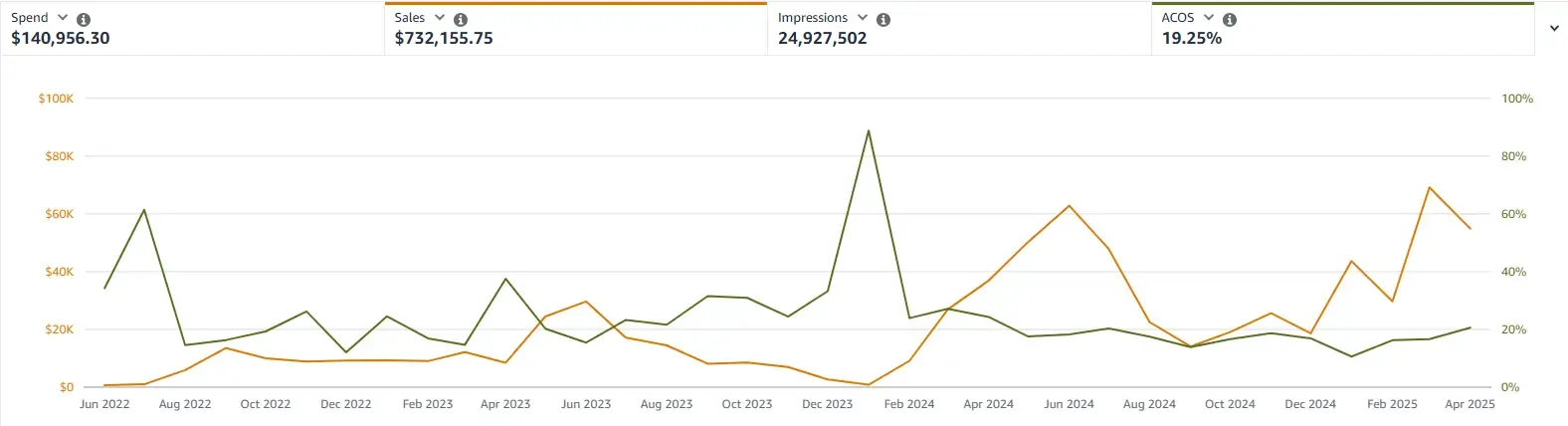
Good PPC shows up as more total sales at a stable or falling TACoS, not just a lower ACoS. Two Horison accounts show the pattern:
- Restructure first. A disorganised account was rebuilt, bids refined and the listing optimised with converting keywords. Sales grew 161% in two months, from $4,088 to $10,707, with ACoS down to 18%.
- Harvest continuously. For a seasonal brand, campaigns were segmented by product and match type, high-converting search terms were harvested into ranking campaigns, and SEO and creatives were improved. Sales grew from $135.98K to $240.16K, up 105% year on year, at under 10% TACoS.
Horison’s own benchmark is a 12.6% average TACoS across managed accounts.
When should you hire help with Amazon PPC?
Get help when PPC needs more hours or skill than you have, and the extra profit would cover the cost. Typical signs:
- Ad spend is growing faster than total sales, so TACoS keeps rising.
- ACoS has sat above break-even for months and you don’t know why.
- Nobody has time for the weekly search-term routine.
- You are launching several products or marketplaces at once.
Run the numbers before you decide: our guide to whether an Amazon agency is worth it shows how to calculate the extra sales an agency needs to pay for itself, and how much an Amazon agency costs covers market fee ranges.
How Horison runs Amazon PPC
Horison Marketing is an Amazon Ads Verified Partner. We set ACoS and TACoS targets from your real margin after VAT and Amazon fees, rebuild structure where it’s needed, and run harvesting, negatives and bid changes every week, with a monthly review of total sales, TACoS and organic versus ad sales. Every account is quoted individually after a free discovery call. See Amazon PPC management for how it works, or book a call to have us look at your account.
Frequently Asked Questions
How should I structure my Amazon PPC campaigns?
Separate campaigns by product (or a tight group of near-identical products), by goal and by targeting type. A common set per product is an auto campaign for discovery, a broad and phrase campaign for research, an exact-match campaign for proven keywords, a product-targeting campaign and a branded-defence campaign. Amazon's own guidance is not to mix targeting strategies in the same campaign and ad group.
How much should I spend on Amazon PPC each month?
Work backwards from a target TACoS. Multiply the total monthly sales you expect by the TACoS you can afford. A brand forecasting £60,000 a month at a 10% TACoS has a £6,000 monthly ad budget, about £197 a day. Launches need more for a period; mature products can often run on less.
What is a good ACoS on Amazon?
Any ACoS below your break-even ACoS, which is your margin before advertising. If you keep 30p from each pound of sales before ads, campaigns under 30% ACoS make money on the first sale. Most brands set a target a few points below break-even and allow higher ACoS on launch and ranking campaigns for a fixed period.
Should I use automatic or manual campaigns on Amazon?
Both. Automatic campaigns find search terms and products you would not have thought of; manual campaigns let you control bids on the terms that convert. Amazon suggests letting an auto campaign run for about two weeks before building manual campaigns from its search term report.
How often should Amazon PPC be optimised?
Review search terms, negatives and bids weekly, budgets and placements every one to two weeks, and strategy (targets, product priorities, launch plans) monthly. Give keywords at least 20 clicks before judging them, as Amazon recommends, so you do not cut terms on too little data.
Is Sponsored Brands worth it?
Usually yes for brand-registered sellers with several products. Sponsored Brands ads appear at the top of search and can link to your Brand Store, which helps shoppers see your range and protects branded searches. Start once Sponsored Products is profitable, and judge Sponsored Brands on new-to-brand customers and total sales as well as ACoS.
When should I hire an Amazon PPC agency?
When ad spend is growing faster than sales, ACoS sits above break-even for months, nobody has time for weekly search-term work, or you are launching products or marketplaces at the same time. Compare the agency fee with the extra profit it needs to create; our guide on whether an Amazon agency is worth it shows the formula.

David Balan is co-founder of Horison Marketing, a full-service Amazon agency that has managed over $1B in lifetime Amazon revenue for brands in the UK, EU and US.