
Selling on Amazon Europe from the UK in 2026: VAT, EPR, Pan-EU and Fulfilment Explained
 David Balan
Co-founder, Horison Marketing11 min read
Since 1 January 2021 the UK and the EU have been separate customs and VAT areas. Selling on Amazon.de or Amazon.fr from the UK therefore means exporting, and the paperwork depends on one decision above all: where your stock sits. Amazon’s Pan-European FBA page lists nine EU stores (Germany, France, Italy, Spain, the Netherlands, Poland, Sweden, Belgium and Ireland), and each one is reachable from the UK.
This is a practical guide, not legal or tax advice. VAT, customs and product rules depend on your products and set-up, so confirm your plan with an accountant who handles EU e-commerce before you ship stock. Rules below are as of October 2026.
What changes when a UK brand sells on Amazon Europe?
Three things change: VAT (who charges it and where you register), customs (who imports the goods) and EU product rules (EPR and product safety). Amazon’s programmes take away some of the work, but legal responsibility for your products stays with you.
| Obligation | What it means for a UK seller | When it applies | Official source |
|---|---|---|---|
| EU VAT registration | A VAT number in each EU country where your stock is stored | Stock in EU warehouses (EFN, Pan-EU, Local Inbounding) | Amazon |
| EU EORI or customs broker | Needed to make import declarations in the EU | When you import stock yourself | GOV.UK |
| EPR registration numbers | Proof you pay for packaging and product recycling in each country | Any sale into countries such as Germany and France | Amazon |
| GPSR Responsible Person | An EU-established operator named on product and listing | Most non-food consumer products | EUR-Lex |
| Local-language listings | Titles, bullets and safety information shoppers can read | Every EU store | Amazon |
Do you need an EU VAT number to sell on Amazon Europe?
You need an EU VAT number only if you store stock in the EU. Amazon’s own guidance is to register “a valid VAT number in each country you plan to store inventory”. If your stock stays in the UK and you use Remote Fulfilment, Amazon says you don’t need a VAT number in the destination store and it collects and remits VAT on those cross-border orders.
Amazon is the “deemed supplier” for most of your EU sales. Since July 2021, when a seller established outside the EU sells goods to EU consumers through a marketplace, the marketplace is treated as the seller for VAT and collects and pays the VAT (Your Europe; Irish Revenue). It doesn’t cancel your registration in a storage country: you still import stock there and move it between warehouses, and your accountant reports that.
OSS and IOSS matter less than most guides suggest. The EU’s Union One Stop Shop lets non-EU businesses declare intra-EU distance sales of goods in one quarterly return, and the Import One Stop Shop (IOSS) covers imported orders up to €150 (Your Europe). For a UK Amazon seller, OSS is mainly relevant to sales you make yourself, such as your own website shipping from EU stock, because Amazon handles VAT on marketplace sales.
Don’t plan around the €10,000 threshold. The EU’s €10,000 distance-selling threshold lets small businesses charge VAT in the EU country where they are established (Your Europe). It is built around EU establishment, so a UK company should not assume it applies.
Worked example: how many VAT registrations?
Example numbers, not a real client. A UK brand with 30 products wants to sell in Germany, France, Italy and Spain.
| Route | Where stock sits | EU VAT registrations | Main limit |
|---|---|---|---|
| Remote Fulfilment | UK FBA warehouses | 0 | Only products priced up to €135 / £122 |
| European Fulfilment Network | Germany only | 1 (Germany) | Cross-border fees on the other stores |
| Pan-European FBA, storage in Germany and Poland | Germany and Poland; Amazon moves stock | 2 | Listings needed in DE, FR, IT, ES and NL |
| Pan-European FBA, storage in all five countries | Germany, France, Italy, Spain, Poland | 5 | Most admin, fastest local delivery |
The brand’s EPR and GPSR obligations are largely the same in every row, because they depend mainly on where products are sold, not where they are stored.
How does stock get from the UK into Amazon’s EU warehouses?
When you send stock into an EU Amazon warehouse yourself, you are the importer of record, so you need an EU EORI number or a customs broker, and you pay import VAT and any duty. Amazon’s own comparison lists the seller as importer for Local Inbounding, and Amazon as the party that handles customs clearance for Remote Fulfilment (Amazon).
- EORI: A GB EORI number covers the UK side. To make a declaration in the EU you need an EORI number from an EU country (or an XI number with a permanent business establishment in Northern Ireland); otherwise, GOV.UK says, you’ll need to appoint someone to deal with customs for you.
- UK VAT on the way out: HMRC’s Notice 703 explains when exported goods can be zero-rated and the evidence you must keep.
- Duty: The UK–EU trade deal removes tariffs only for goods that meet the rules of origin. Products made outside the UK and simply resold from a UK warehouse usually won’t count as UK origin, so duty may apply.
- Brokerage: Amazon offers Customs Clearance and Shipping Services for brokerage, indirect representation and transport between the UK and EU, and Amazon Global Logistics can ship ocean freight from China straight into its EU network (Amazon).
New in 2026: a €3 duty on low-value parcels. From 1 July 2026 the EU charges a temporary €3 customs duty per item on parcels worth up to €150 imported from outside the EU, and the seller or importer is responsible for declaring and paying it (European Commission). That is relevant to orders you ship from the UK to EU shoppers. As of October 2026, check how it shows in your Amazon fees and settlement reports, and ask your broker how it applies to your goods.
What are EPR obligations, and what does Amazon check?
Extended Producer Responsibility (EPR) makes the business that puts a product or its packaging on a country’s market pay for collecting and recycling it. Amazon asks for your registration numbers as proof, and may deactivate non-compliant listings or comply on your behalf. Rules are set country by country, and packaging, electrical equipment and batteries are the most common categories.
- Germany: Amazon says sellers “offering products for sale in Germany” must meet EPR rules for packaging and for electrical and electronic equipment. For packaging you register in the LUCID packaging register and give Amazon your LUCID number; for electrical equipment you register with stiftung ear, which also administers Germany’s batteries law.
- France: Amazon lists 19 EPR categories on Amazon.fr (its count as of 2024), including electrical equipment, batteries, packaging, furniture, textiles, toys, DIY and sports goods. You need a Unique Identification Number (UIN) for each category you sell, and you pay eco-contributions to the relevant producer responsibility organisation (Amazon).
- Other countries: Requirements differ in every country, and Amazon publishes separate guidance for countries such as Austria. Check each store before you list in it.
The EU packaging regulation now applies. The Packaging and Packaging Waste Regulation has applied since 12 August 2026 (European Commission). It includes a duty for producers selling to consumers in EU countries where they aren’t established to appoint an authorised representative there. The Commission proposed suspending that duty in December 2025, and as of October 2026 its page says the proposal is still under review, so ask your EPR provider what applies to you.
What does GPSR mean for UK brands selling in the EU?
Since 13 December 2024, the EU General Product Safety Regulation requires most non-food consumer products sold in the EU to have an economic operator established in the EU who is responsible for them. Online listings must show the manufacturer’s name and contact details, the EU Responsible Person where the manufacturer is outside the EU, a product identifier, and any warnings or safety information.
Amazon’s GPSR announcement sets out what it checks:
- You submit Responsible Person and manufacturer details for your EU stores through the Manage your compliance dashboard in Seller Central.
- Amazon shows those details on the product detail page.
- Non-compliant listings risk removal.
- The UK store doesn’t need this information submitted.
A UK office address does not meet the EU-establishment requirement. The regulation accepts an EU-based manufacturer, importer, authorised representative or fulfilment service provider, so UK brands usually appoint an EU importer, set up an EU subsidiary or use an authorised representative service.
Pan-European FBA, EFN or Remote Fulfilment: which should you choose?
For most UK brands, the sensible order is: test with Remote Fulfilment, move best sellers into EU warehouses, then consider Pan-European FBA once several EU stores are paying their way. Amazon gives the same advice: use Remote Fulfilment to test demand, and move your best-selling products to Local Inbounding for faster delivery.
| Remote Fulfilment | European Fulfilment Network (EFN) | Pan-European FBA | |
|---|---|---|---|
| Where stock sits | UK FBA | One EU country | At least two of DE, FR, IT, ES, PL; Amazon moves stock |
| EU VAT registrations | None in the destination | The storage country | Each storage country |
| Stores covered | DE, FR, IT, ES, SE, NL | Other EU stores from one hub | DE, FR, IT, ES and NL required; SE, IE and PL optional |
| Price limit | Up to €135 / £122 | None | None |
| Fees | Remote Fulfilment fees | Local fees at home, cross-border (EFN) fees elsewhere | Local fees in storage countries, EFN fees elsewhere |
| Shopper experience | Delivered as an import | Fast in the hub country | Fast local delivery across storage countries |
| Customs | Amazon clears customs | You import into the hub | You import into the EU |
Sources: Amazon’s UK–EU fulfilment page and Pan-European FBA page, as of October 2026.
Three dates to note for Pan-European FBA (Amazon):
- 3 September 2026: every Pan-EU product needs an active Netherlands offer to enrol and keep Pan-EU benefits.
- 26 February 2027: Amazon plans to require an active Belgium offer at enrolment too.
- 17 April 2026: a 1.5% fuel and logistics surcharge was added to FBA fulfilment fees in the UK and EU stores.
Amazon’s FBA Revenue Calculator compares the fees of standard FBA, Remote Fulfilment and Pan-European FBA for your products.
How should you localise listings for Amazon.de, .fr, .it and .es?
Localising a listing means rebuilding it for each market (local keywords, units, sizes and safety text), not just translating it. Amazon’s Build International Listings tool can create and translate offers from your UK listing and keep prices in sync (Amazon). Treat its output as a first draft.
- Keyword research per store. Germans and Italians don’t search with translated English phrases. Research search terms on each store, then write titles and backend keywords around them.
- Native-speaker review. Check titles, bullets, A+ content and any text inside images.
- Safety and compliance text in the local language, matching what’s on the pack.
- Separate PPC per marketplace, with local keywords, budgets and bids. Don’t copy UK campaigns across.
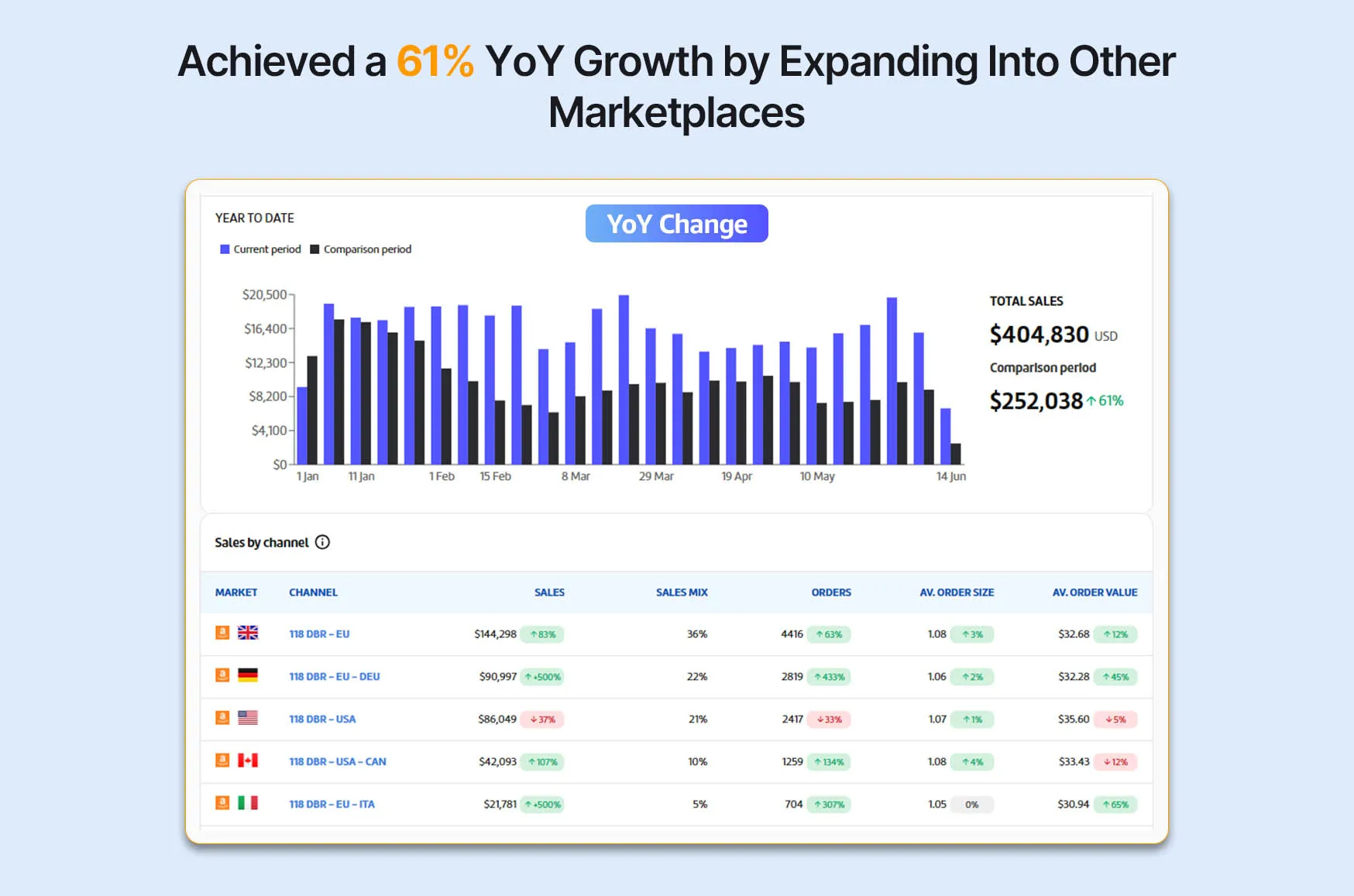
This is what worked for a pet grooming brand facing rising competition in the US and UK. We localised its listings for each target store (translation, keyword research and local guidelines) and ran a separate PPC plan per marketplace. The result was 61% year-on-year account revenue growth year to date, with sales in Germany and Italy up 500% year on year. Our Amazon SEO team handles the listings side; the PPC team builds the campaigns.
Two episodes of our podcast, The Seller’s Journey, cover cross-border expansion in more depth. In episode 11, Natalia from Avask talks through the basics of global e-commerce expansion. In episode 3, Drew Cooper, Head of Sales at Expandly, discusses the tools and strategies brands use to expand into new regions.
A launch order that avoids the common mistakes
- Pick products and stores with Amazon’s Marketplace Product Guidance and FBA Revenue Calculator.
- Check compliance first: GPSR Responsible Person and EPR registrations for each target country.
- Choose a fulfilment route and, if you’ll hold EU stock, register for VAT and line up an EU EORI or broker.
- Build localised listings and launch PPC per marketplace.
- Review after a full quarter, then move proven sellers into EU stock.
EPR or GPSR gaps usually show up first as deactivated listings and compliance flags on your Account Health page. Our guide to the Amazon Account Health Rating explains how to read and fix them.
How Horison helps UK brands expand into Europe
Horison Marketing is a UK-based Amazon agency and Amazon Ads Verified Partner that has managed more than 200 brands. For European expansion we handle the Amazon side: choosing stores and fulfilment routes, localised listings, PPC per marketplace, and keeping listings compliant and live. VAT returns, customs and legal sign-off stay with your accountant and compliance providers. See our Amazon account management service, or book a free discovery call to talk through your EU plan.
Frequently Asked Questions
Can I sell on Amazon Germany from the UK without an EU VAT number?
Yes, if you don't store stock in the EU. With Amazon's Remote Fulfilment, your UK FBA stock serves orders on Amazon.de, .fr, .it, .es, .se and .nl, Amazon collects and pays the VAT on those cross-border orders, and you don't need a VAT number in the destination country. Items must be priced at no more than €135 (£122). Once you store stock in an EU warehouse, you need a VAT registration in that country.
Does Amazon collect VAT for UK sellers on its EU stores?
For most consumer sales, yes. Under the EU e-commerce VAT rules, when a seller established outside the EU sells goods to EU consumers through a marketplace, the marketplace is treated as the supplier and collects and pays the VAT. You still need your own VAT registration in any EU country where you store stock, and an accountant to file those returns.
Do I need an EU EORI number to sell on Amazon Europe?
Only if your business imports stock into the EU itself, for example when you send inventory to an Amazon warehouse in Germany. A GB EORI number doesn't let you make customs declarations in the EU; you need an EORI number from an EU country, or a customs broker who acts for you. With Remote Fulfilment, Amazon handles customs clearance.
What EPR registrations do I need to sell on Amazon.de and Amazon.fr?
In Germany, Amazon asks for your LUCID number for packaging, and sellers of electrical or electronic equipment must also register with stiftung ear. In France, you need a Unique Identification Number for each EPR category you sell, such as packaging, electrical equipment, batteries, furniture, textiles or toys. Amazon can deactivate listings that lack valid numbers.
Do UK brands need an EU Responsible Person for Amazon?
Yes, for most non-food consumer products sold on Amazon's EU stores. Since 13 December 2024, the EU General Product Safety Regulation requires an economic operator established in the EU for each product, and its details must appear on the product or packaging and in the listing. A UK address is not enough.
Should a UK seller use Pan-European FBA or Remote Fulfilment?
Use Remote Fulfilment to test demand for products under €135 with no EU VAT registrations. Move proven best sellers into EU warehouses for faster, cheaper local delivery. Pan-European FBA suits brands selling across several EU stores that can manage at least two EU VAT registrations and listings in Germany, France, Italy, Spain and the Netherlands.
Do I need to translate my Amazon listings for Europe?
Yes. Shoppers on Amazon.de, .fr, .it and .es search in their own language, so each listing needs local keywords, not just a translation. Amazon's Build International Listings tool can create and translate offers from your UK listing, but have a native speaker check titles, bullets and safety information before you launch.

David Balan is co-founder of Horison Marketing, a full-service Amazon agency that has managed over $1B in lifetime Amazon revenue for brands in the UK, EU and US.